What Is a Prompt?
If you’re thinking about what is prompt, the simple answer is: it is a question or instruction you give to an AI tool to get a specific response for a specific question.
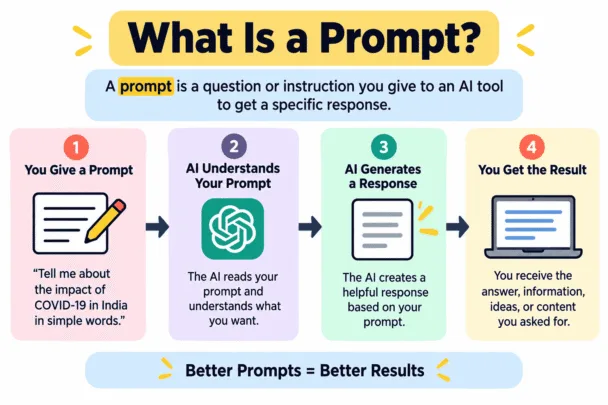
For example, if you ask an “AI like Gemini”, “make me a prompt to generate a beautiful photo of mine,” that message is your instruction. The AI uses your instructions to understand what you want and generates a response based on them.
What Does a Prompt Do?
A prompt tells the AI what you want it to do. It can be used to ask questions, write content, generate ideas, summarize information, create images, etc.
For example:
“Tell me about the impact of covid-19 in India in simple words.”
This tells the AI both what topic to explain and how you want the explanation.
Prompt Examples
Here are some simple examples of prompts:
- “Write a blog introduction about ( blog which you want to get explained ).”
- “Explain photosynthesis in simple English.”
- “Give me 10 yoga aasan which i can do in the morning.”
- “Create a professional email for a ( whatever the subject is ).”
- “Generate a realistic image of a ( whatever you want ).”
Prompt vs. Question
A question is asked to get information of whatever we want, while a prompt can be a question or an instruction.
For example:
Question: “What is the prompt?”
Prompt: “Explain prompt in simple English.”
So, a question can be a prompt, but a prompt need not be always a question.
Why Do Prompts Matter in Generative AI?
The way you write a prompt can affect the response you get from AI. A clear and specific prompt gives the AI more information about what you actually want.
This leads to another important topic, what is prompt engineering?
Prompt engineering is the art and science of writing clear, structured instructions—called prompts—to guide an artificial intelligence (AI) toward giving you the exact answer or result you want.
What Is an AI Prompt?
If you’re searching for what is a prompt?, an AI prompt is simply the text you give to an artificial intelligence to tell it what you want. It can be a question, or a detailed request that guides the AI’s response.
For example:
“What is climate change?”
This is a question asking for information.
But:
“Write a 500-word article about climate change for beginners.”
is an instruction that tells the AI what to create, how long it should be, and who it should be written for. Both are prompts in artificial intelligence, even though they have different purposes.
AI Prompt vs. Normal Question or Instruction
A normal question usually asks for an answer, while an instruction tells someone what to do. An AI prompt can combine both and provide additional details such as tone, format, length, audience, or style.
For example, instead of simply asking:
“Explain artificial intelligence.”
you could write:
“Explain artificial intelligence in simple English with three real-world examples.”
The second AI instruction gives the AI more context, making the expected result clearer.
Understanding AI prompt meaning is also the first step toward understanding what is prompt engineering—the practice of creating and refining prompts to get more useful results from AI.
What Is Prompt Engineering?
If what is a prompt is about telling the AI what you want, what is prompt engineering is about learning how to give those instructions more effect.
prompt engineering means creating, refining, and structuring instructions to get more useful, accurate, and consistent results from AI models.
Why Does Prompt Engineering Matter?
A well-written instructions gives AI clearer context and direction, which can improve the quality of its response. This becomes especially useful for complex tasks.
How Does Prompt Engineering Work?
It involves understanding the goal, writing a clear prompt, testing the AI’s response, and improving the prompt when needed. This process is often called AI prompt engineering.
Prompt Engineering vs. Ordinary Prompting
Ordinary prompting might be as simple as asking, “write a blog about ( subject of your choice ).”
Prompt engineering adds useful details, such as:
“Write a 1,000-word beginner-friendly blog about ( your subject ), using simple language and clear headings.”
The second approach gives the AI more context and specific instructions.
Who Uses Prompt Engineering?
Prompt engineering is used by content creators, developers, marketers, researchers, students, businesses, and anyone who regularly works with AI tools.
In simple words, this prompt engineering explained, approach helps people communicate more clearly with AI and get results closer to what they actually need.
How Does Prompt Engineering Work?
Now that you know what is a prompt and what is prompt engineering, the process is actually quite simple. You create clear instructions, check the AI’s response, and improve the prompt until you get the result you need.
The basic process is:
- Define the goal – Decide what you want the AI to do.
- Add context – Give relevant information the AI needs.
- Specify the output – Mention the format, tone, length, or style.
- Set constraints – Add any rules or limitations.
- Give examples – Show the AI what you expect when necessary.
- Test and refine – Check the response and improve the prompt.
In short, prompt engineering is a process of writing, testing, and refining prompts to get better AI results.
What Are the Different Parts of a Prompt?
A prompt can be simple, but adding the right details can make it much more effective. The main parts of a prompt can include:
- Role: Tell the AI what role to take.
- Task: Clearly state what you want it to do.
- Context: Add background information it needs.
- Input: Provide the information or content it should use.
- Constraints: Mention limits, rules, or things to avoid.
- Examples: Give an example when you need a specific type of response.
- Output format: Tell it whether you want a paragraph, list, table, etc.
- Tone/style: Describe how you want the response to sound.
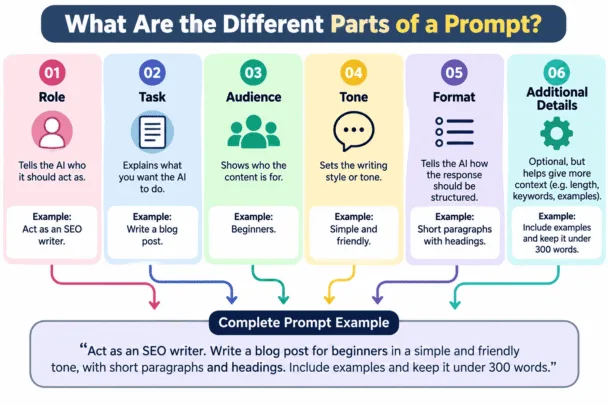
For example:
Role: Act as an SEO writer.
Task: Explain prompt engineering.
Audience: Beginners.
Tone: Simple and conversational.
Format: Short paragraphs with headings.
These components form the basic AI prompt structure, helping the AI to understand both the task and the type of answer you expect.
Types of AI Prompts
Now that we understand what is a prompt and what is prompt engineering, it’s useful to know thatinstructions can be written in different ways depending on the task.
Instruction Prompts
Tell AI what to do.
Example: “Summarize this article in 100 words.”
Question Prompts
Asks AI for information or an explanation.
Example: “How does machine learning work?”
Creative Prompts
Used to generate creative content such as stories or ideas.
Example: “Write a short mystery story set in a small village.”
Role-Based Prompts
Gives AI a specific role or expertise.
Example: “Act as a career advisor and suggest skills for a beginner.”
Context-Based Prompts
Provide BG information before giving the task.
Example: “I’m a college student with a limited budget. Suggest few laptops for me.”
Few-Shot Prompts
Provides few examples to show AI what kind of response you want.
Example: “Happy → Positive, Angry → Negative, Excited → ?”
Zero-Shot Prompts
Gives the AI a task without providing examples.
Example: “Classify this review as positive or negative.”
Chain-of-Thought-Related Prompting
This approach encourages the model to work through a problem systematically rather than simply giving an answer.
Example: “Solve this problem step by step and provide the final answer.”
Structured Prompts
These organize instructions into clear sections or requirements.
Example: “Give the answer with: Definition, Benefits, Examples, and Conclusion.”
Multimodal Prompts
These combine text with other inputs, such as images, audio, or video.
Example: “Look at this image and describe what is happening in it.”
Choosing the right prompt type can make your instructions clearer and help you get more relevant results from AI.
Limitations of Prompt Engineering
Prompt engineering can help you get better results from AI, but it has its limits. A well-written instruction doesn’t automatically make the AI’s answer correct.
- AI can still hallucinate: Sometimes AI gives information that sounds convincing but is actually wrong.
- Good prompts don’t guarantee accuracy: Even a detailed prompts can produce an incorrect answer.
- Context has limits: AI models can only handle a certain amount of information at once.
- Models behave differently: The same input may give different results in different AI models.
- Results can change over time: A instruction that works well with one model version may behave differently after an update.
- Some answers need verification: For topics like medical, legal, financial, or other sensitive information, AI responses should be checked against reliable sources.
So, what is prompt engineering really about? It’s a way to communicate more effectively with AI—not a guarantee that every response will be perfect.
Frequently Asked Questions
- What is a prompt?
A prompt is a question, instruction, or request you give to an AI tool to get a specific response. - What is prompt engineering?
Prompt engineering is the process of writing, testing, and improving prompts to get more useful and consistent results from AI. - Why are prompts important in AI?
They give AI direction and context, helping it understand what you want and how you want the response. - What makes a good AI prompts?
A good instruction is clear about the task and includes useful details such as context, audience, format, or tone when needed. - Does prompt engineering guarantee better answers?
No. Better input can improve results, but AI can still make mistakes, misunderstand information, or provide inaccurate answers. - What are the different types of AI prompts?
Common types include instruction, question, creative, role-based, context-based, few-shot, zero-shot, structured, and multimodal prompts. - Is prompt engineering difficult to learn?
Not necessarily. You can start with simple inputs and improve them by adding clearer instructions, relevant context, and specific requirements.